
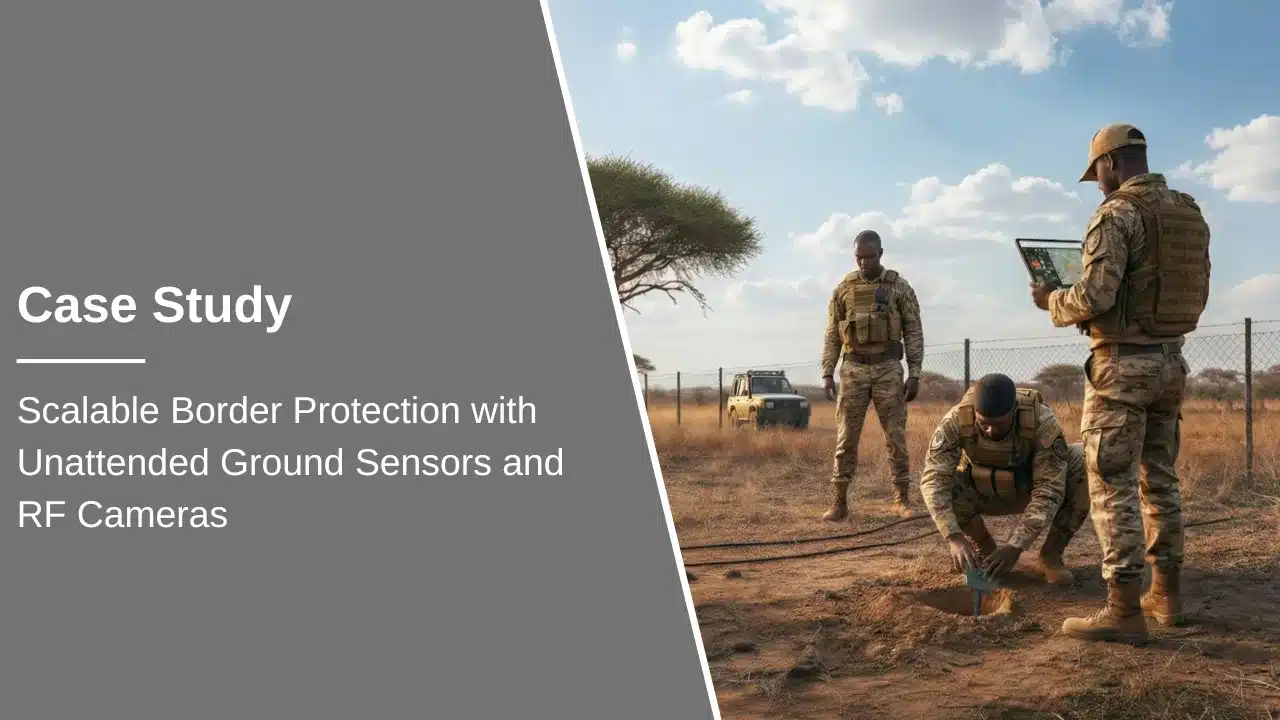
Case Study: Scalable Border Protection with Unattended Ground Sensors and RF Cameras
Protecting a long border is never about one device or one location. The challenge is scale: hundreds of remote points, limited infrastructure, difficult terrain, and the constant need to detect and verify threats early enough to act.
That is the context behind this project in Africa.
For this deployment, we designed a border protection architecture built around AIO XR sensors, CovertEye RF cameras, and CCS-OnSite. With hundreds of kits deployed across hundreds of locations, the system creates a distributed detection and verification network that feeds a centralized command and control center.
The value of this approach is clear. Instead of relying on isolated field systems or infrastructure-heavy surveillance layouts, we can extend detection across remote terrain, support visual verification where it matters, and manage the entire deployment through one operational framework.
A Border Project Built for Scale
Remote border environments place very different demands on a security system than a fenced site or fixed facility.
Traditional fence-based technologies only work where there is a defined physical barrier. Standard CCTV requires power, communications, and continuous visibility. In remote sectors, those requirements quickly become a burden.
Large border deployments need a different structure. They need a field layer that can be distributed across wide terrain, a verification layer that gives operators visual context, and a command layer that ties all locations together.
That is exactly how this project was built.
The Detection Layer: AIO XR
At the center of the field deployment are our AIO XR sensors, installed across the border as part of a large-scale unattended ground sensing network.
In a project like this, the real advantage is not a single detection point. It is the ability to build an organized, repeatable field architecture across many remote locations. Each kit becomes part of a wider system, giving security teams visibility across the protected area rather than only at selected infrastructure points.
This makes AIO XR especially suitable for border environments where coverage and scalability matter more than visibility. The sensors can be deployed as part of a structured field layout, supporting a broad-area security concept without creating a large visible footprint.
For border operators, that means better reach across remote sectors and a more practical way to establish persistent awareness over a large area.
The Verification Layer: CovertEye RF
Detection alone is not enough. Once activity is identified, operators need a way to understand what triggered the event.
That is where CovertEye RF adds real operational value.
CovertEye RF is designed for remote locations where conventional infrastructure is limited or unavailable. In this project, it gives us a visual verification layer that works alongside the sensor network and supports faster, more informed decision-making.
This is important because border teams do not benefit from alarm volume alone. They benefit from context. A detection event becomes much more useful when it can be paired with image-based verification from the same remote sector.
CovertEye RF strengthens that workflow by bringing visual confirmation into areas where fixed surveillance infrastructure would be difficult, expensive, or impractical to deploy.
Instead of trying to build a conventional camera system at every location, we add targeted visual verification to a distributed field architecture. That makes the overall solution more flexible and far more scalable.
The Command Layer: CCS-OnSite
A project with hundreds of field kits only becomes truly effective when all events can be managed from one place.
That is the role of CCS-OnSite.
CCS-OnSite gives the command center one unified environment for monitoring the deployment, handling alarms, and maintaining visibility across the full border protection layout. Rather than treating each remote location as a separate security point, operators can work from a centralized operational picture.
This is a major advantage in border protection. Once deployments reach this scale, command and control becomes just as important as the field hardware itself. Without a central software environment, large systems become harder to manage, slower to interpret, and more difficult to scale.
With CCS-OnSite, the field network remains connected to one operational logic. That supports faster response, better coordination, and stronger control over the full deployment footprint.

Why This Architecture Works
The strength of this project is not in any one component by itself. It comes from the way the layers work together.
AIO XR creates a distributed ground-based detection network across the border.
CovertEye RF adds remote image-based verification.
CCS-OnSite centralizes control across all locations.
Together, they create a practical model for wide-area border protection.
This matters because large border environments are rarely protected effectively by single-layer systems. A camera-only approach creates infrastructure demands and monitoring burden. A detection-only approach gives less context. A command layer without proper field coverage cannot deliver real operational value.
By combining detection, verification, and centralized control, we built a system that is better suited to remote terrain and large deployment numbers.
Operational Benefits for Border Security Teams
This type of architecture brings several clear advantages to border protection operations.
Wider area coverage
A distributed sensor-and-camera model allows us to cover many remote points across a long border line without concentrating security only in a few visible locations.
Better event understanding
Visual verification gives operators more confidence when assessing alarms and deciding how to respond.
Stronger central control
A single command environment makes it easier to supervise field activity across a wide area and maintain a consistent operational workflow.
Better fit for remote conditions
The project is designed for locations where infrastructure cannot be assumed at every point, which is often the reality in border security.
Greater scalability
Because the system is organized as repeatable field kits connected to one command center, it supports large deployment numbers much more effectively than standalone site-by-site solutions.
A Better Alternative to Traditional Border Security Layouts
Many legacy border deployments are built around isolated technologies. One site may have sensors. Another may rely on cameras. A third may depend mainly on patrol activity. That kind of fragmentation makes it difficult to build a coherent operational picture.
This project follows a different logic.
Instead of deploying separate tools with limited coordination, we created one system architecture that extends from the field to the command center. The sensor layer identifies activity. The camera layer provides verification. The software layer centralizes management.
That structure is much better suited to modern border operations, especially where the protected area is large and the number of locations is high.
Technical Snapshot
Component | Role in the Project | Operational Contribution |
AIO XR | Field detection layer | Distributed sensing across hundreds of border locations |
CovertEye RF camera | Visual verification layer | Remote image-based verification in infrastructure-limited areas |
CovertEye RF base station | RF communications layer | Supports transmission from remote camera points into the system |
CCS-OnSite | Command and control | Centralized monitoring, alarm handling, and system visibility |
OutWatch | Optional verification layer | Helps deliver verified alerts and reduce unnecessary alarm burden |
Frequently Asked Questions (FAQ)
Why are unattended ground sensors useful in border protection?
They allow security teams to extend detection across remote terrain without needing permanent crewed coverage at every point.
Why combine sensors with RF cameras?
Because detection is much more valuable when operators can quickly verify what triggered the event.
Why is RF important in a project like this?
RF communication supports remote deployments where conventional infrastructure is limited or unavailable.
What does CCS-OnSite add to the system?
It brings all field activity into one centralized command-and-control environment, making the deployment easier to manage at scale.
Why is this model better suited to large borders?
Because it is designed as a distributed architecture with centralized oversight, rather than as isolated site-based systems.
Conclusion
Border protection at this scale requires more than standalone technologies. It requires an operational architecture that can extend across remote terrain, support fast verification, and keep the full deployment under centralized control.
That is what we delivered in this project.
By combining AIO XR, CovertEye RF, and CCS-OnSite, we created a border protection system built for large-scale deployment across hundreds of locations. The result is a more practical way to detect, verify, and manage activity along remote border sectors from one command center.
This is the direction modern border protection needs to take: distributed field awareness, remote verification, and centralized operational control working together as one system.

