
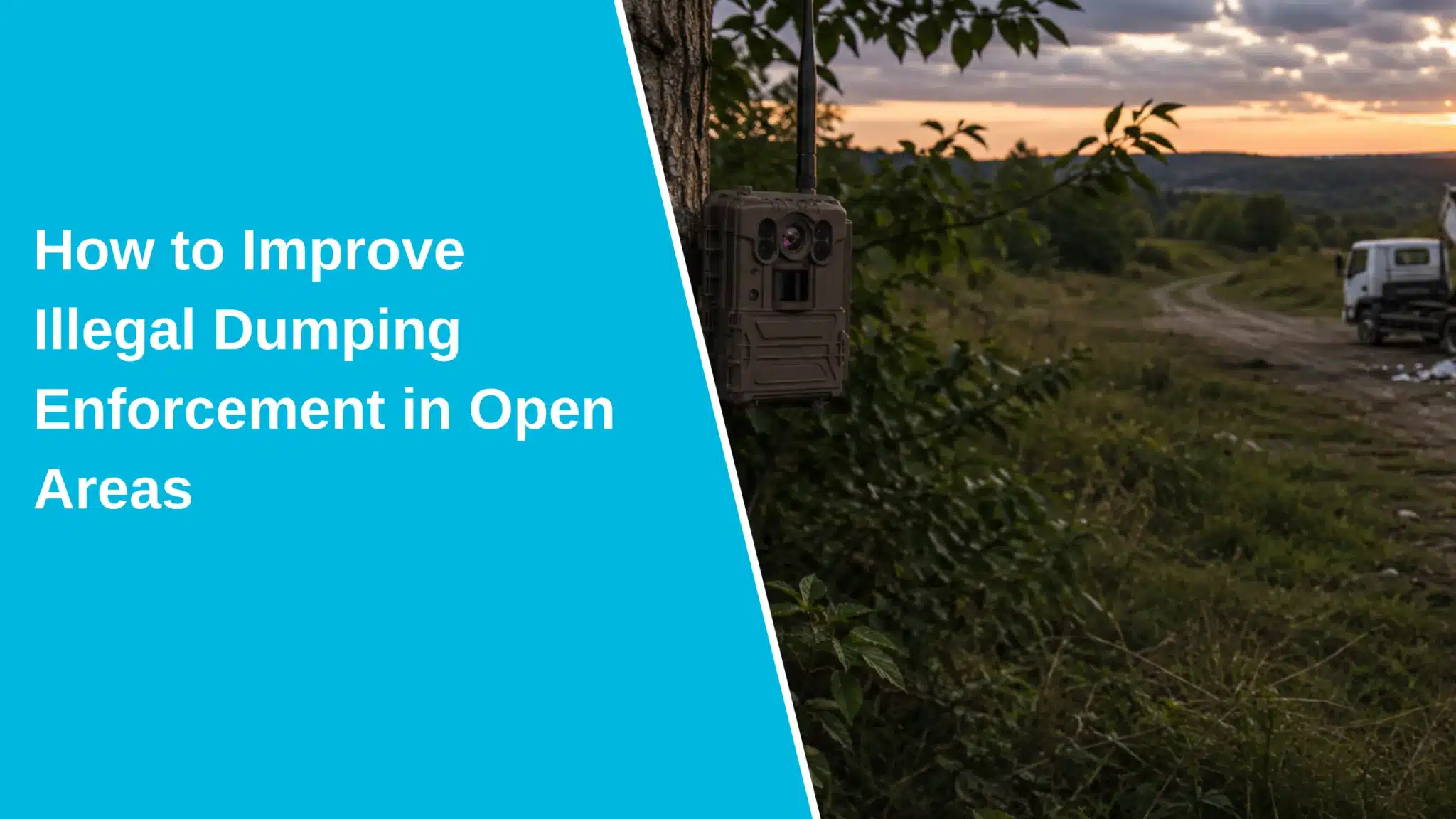
How to Improve Illegal Dumping Enforcement in Open Areas
How to Improve Illegal Dumping Enforcement in Open Areas
Illegal dumping rarely happens where enforcement teams have the advantage. It happens in open land, remote roadside zones, agricultural edges, utility corridors, woodland access points, and unmanaged transition areas where visibility is low and manpower is limited. These are exactly the places where standard CCTV struggles. A visible camera is easy to spot, easy to avoid, and easy to work around. Once offenders know where the camera is, they simply move a few meters away, change approach direction, or dump outside the scene.
That is why we approach illegal dumping enforcement differently. In open areas, we need covert equipment, fast installation, independent power, wide-area coverage, high-resolution image capture, and verified alerts that do not drown teams in noise. This is where we use CovertEye 4G + OutWatch. CovertEye 4G gives us a covert, autonomous camera for remote locations without infrastructure. OutWatch adds AI-based verification, reduces false alarms by about 95%, and sends only verified alerts of interest to the user. Together, they create an efficient enforcement workflow for organizations that manage many sites with minimal staff.
Why illegal dumping in open areas is so difficult to enforce
Illegal dumping is an enforcement challenge because the operational reality is stacked against the authority. Sites are often remote or unattended, there is usually no possibility of immediate interception, and one team may be responsible for dozens or hundreds of hotspots. In many cases, the goal is not to stop the act in real time. The goal is to document it clearly enough to support investigation, deterrence, and prosecution.
That changes the system requirement completely. We do not need a basic visible camera that records general motion. We need a covert camera that can be deployed quickly, cover a broad scene, remain operational on battery or solar power, and capture images with enough quality to understand what happened. We also need a server workflow that allows enforcement teams to focus on genuine dumping events rather than wasting hours on animals, weather, and irrelevant movement. That is exactly the operational gap CovertEye 4G + OutWatch is built to close.
Why visible CCTV is the wrong fit for illegal dumping hotspots
Open-area illegal dumping is one of the clearest examples of why visible CCTV is not enough. In a fixed urban setting, a visible camera can influence behavior because the monitored zone is controlled and predictable. In an open dumping site, the opposite is often true. If offenders can identify the camera, they can simply shift to another dumping angle, another corner of the lot, or another nearby location.
That is why covert deployment matters. CovertEye 4G is optimized for discreet deployments and for remote, infrastructure-free locations. It supports battery or solar-powered operation, includes GPS, tamper detection, 4G LTE communications, and secure AES-256 communications via HTTPS. This lets us install quickly, hide effectively, and keep the system operational without depending on local power or communications.
For illegal dumping enforcement, covert deployment is not a nice extra. It is a core requirement. A system that is easy to see is also easy to avoid.
Why wide-area coverage matters in dumping enforcement
Illegal dumping does not always unfold in one clean motion. A vehicle may approach slowly, stop outside a narrow frame, reposition, unload from different sides, or leave material across a spread-out area. If the camera sees only a tight segment of the event, the enforcement team may receive an alert without understanding the full situation.
That is why we value broad scene awareness so highly in this use case. CovertEye 4G combines a 110° wide-angle view with PIR detection up to 25 meters and IR illumination up to 25 meters. This allows us to cover a large operational area and capture the wider context around the event rather than a narrow slice of movement. For open dumping sites, this is critical. Better scene coverage means better situational understanding: what arrived, where it stopped, what was unloaded, and how the event developed.
Why image quality matters more than live response
In illegal dumping, immediate response is usually the exception, not the rule. Most enforcement teams are managing too many locations with too few people to dispatch in real time every time motion appears. That means evidence quality matters enormously.
CovertEye 4G supports image resolutions up to 32MP, and the OutWatch workflow lets teams review alarms with image details, prediction data, and historical events from web or smartphone access. In this type of enforcement, we are not trying to create a vague motion trail. We are trying to create usable evidence and a clear post-event picture. Good-quality images are essential because they support reporting, internal review, escalation, and prosecution.
Why false alarms make illegal dumping enforcement inefficient
A dumping hotspot is usually exposed to everything that causes nuisance alarms: changing light, wind, vegetation movement, animals, and environmental motion. Traditional surveillance systems often struggle in these locations, producing frequent false alarms and wasting the time of teams that are already understaffed. Our own illegal dumping use case for OutWatch is built around this exact challenge.
OutWatch solves that by analyzing alarm images with our proprietary AI Vision model, classifying threats, and reducing false alarms by approximately 95%. We can also define the objects of interest and tune sensitivity for the site. In illegal dumping enforcement, that is especially valuable because the relevant event is often vehicle-led. OutWatch can be configured to alert only when trucks are detected, which helps reduce non-actionable noise even further.
This matters not only for convenience, but for enforcement economics. One operator can oversee more sites, spend less time reviewing nuisance activity, and focus attention on verified events that justify investigation.
How CovertEye 4G + OutWatch creates an efficient enforcement workflow
The workflow is straightforward.
CovertEye 4G is deployed covertly at the dumping hotspot. Because it is built for remote, infrastructure-free locations, we can install it quickly and operate it on rechargeable battery, DC 12V, or solar power. The camera detects activity using PIR and embedded vibration sensing, captures high-quality images, and sends events through 4G LTE.
OutWatch then processes the alarm images through our AI Vision analytics model. The system classifies threats, filters out false triggers, and forwards verified push notifications to the user. Teams can review alarms and manage cameras from PC or smartphone, which is especially important when many dumping sites are spread across a region. OutWatch is also an open platform, supporting trail cameras and IP cameras with alarm notification via email, and today the platform services more than 10,000 cameras/NVRs overall across deployments.
That combination gives us exactly what illegal dumping enforcement needs:
covert deployment, remote autonomy, broad-area visibility, verified alerts, and an efficient operating model for many sites with limited manpower.

Why GDPR compliance matters for EU public bodies
For municipalities, public authorities, and official bodies in the EU, illegal dumping enforcement is not only an operational challenge. It is also a data-governance issue. Video images can contain personal data, which means surveillance deployments must be structured carefully.
The European Commission states that organizations processing personal data under the GDPR must respect principles such as lawfulness, fairness and transparency, purpose limitation, data minimisation, storage limitation, integrity and confidentiality, and accountability. The Commission also states that data should be stored only for the shortest time necessary and that organizations should define review or erasure periods. The European Data Protection Board’s video-device guidance specifically notes that the general GDPR principles should always be carefully considered in video surveillance.
That is why the server side matters. For EU official bodies, images should be handled in a GDPR-compliant environment with controlled access, clear retention logic, and a tightly defined enforcement purpose. CovertEye 4G is positioned with secured cloud (GDPR compliant) alongside encrypted communication and encrypted storage, which aligns well with the needs of public-sector deployments that require both evidence capture and disciplined data handling.
Why this matters when staff are limited and sites are many
Illegal dumping enforcement is almost always a scale problem. Teams rarely monitor one hotspot. They monitor many. The sites are spread out, inspection cycles are thin, and there is rarely enough manpower to treat every alert as urgent.
That is why efficiency is not optional. Our enforcement model has to let a small team cover a large number of sites without being buried in irrelevant alerts. OutWatch was built for centralized management of outdoor cameras, with map-based views, smartphone access, browser access, and verified push notifications. Its role in remote areas is clear: empower law enforcement and security teams to monitor isolated locations with limited presence while still receiving real-time alerts for suspicious activity.
This is also where the open-area fit of CovertEye 4G becomes so valuable. We can install quickly, avoid infrastructure projects, cover a broad scene, and move or scale the deployment as dumping patterns shift.
Technical specifications: CovertEye 4G + OutWatch for illegal dumping enforcement
Specification | Detail |
Deployment type | Covert autonomous camera for remote, infrastructure-free locations |
Connectivity | 4G LTE |
Power | Rechargeable lithium battery pack / DC 12V / solar panel |
Detection | PIR + embedded vibration/tamper detection |
PIR detection range | Up to 25m |
IR range | Up to 25m, 940nm invisible IR |
Field of view | 110° |
Image resolution | Up to 32MP |
GPS | Built-in |
Communication security | AES-256 via HTTPS |
Storage security | Encrypted SD card with AES-256 |
Cloud | Secured cloud, GDPR compliant |
OutWatch function | AI-based alarm verification and centralized monitoring |
False alarm reduction | About 95% |
Threat filtering | Humans, animals, vehicles, trucks; sensitivity and ROI configurable |
Build illegal dumping enforcement around covert evidence and verified alerts
When we deal with illegal dumping in open areas, the challenge is not simply seeing motion. The challenge is capturing the real event, understanding the full scene, and doing it across many sites with limited staff and no practical option for immediate response.
That is why we use CovertEye 4G + OutWatch. It gives us covert deployment, fast installation, battery or solar operation, broad-area scene coverage, high-resolution images, GDPR-aware server positioning for EU public bodies, and AI-based verification that cuts false alarms dramatically. For municipalities, environmental agencies, land managers, and enforcement teams, this is the practical way to make illegal dumping enforcement more efficient, more scalable, and far more usable in the field.
Frequently Asked Questions (FAQ)
What is the best camera system for illegal dumping enforcement in open areas?
We use a covert, autonomous camera with AI verification. CovertEye 4G gives us remote deployment without infrastructure, and OutWatch filters the alarms so teams receive verified events instead of constant nuisance triggers.
Why is a covert camera better than visible CCTV for illegal dumping?
Because visible cameras are easy to avoid in open terrain. A covert deployment is much harder to detect and gives us a better chance of capturing the actual event rather than pushing offenders a few meters outside the scene.
Why is wide-area coverage important in illegal dumping surveillance?
Because dumping usually happens across an open scene, not a narrow doorway or a fixed entry point. The 110° view and 25m detection/IR range help us capture the broader context around the event.
How does OutWatch improve illegal dumping enforcement?
OutWatch analyzes alarm images, reduces false alarms by about 95%, allows threat selection and ROI tuning, and can be configured to alert only for relevant objects such as trucks. That makes enforcement much more efficient for small teams covering many sites.
What should EU public bodies consider for GDPR-compliant dumping surveillance?
They should ensure the deployment follows GDPR principles including purpose limitation, data minimisation, storage limitation, and secure handling of personal data. In practice, that means using a compliant server environment, restricting access, and defining retention periods appropriate to the enforcement purpose.

