
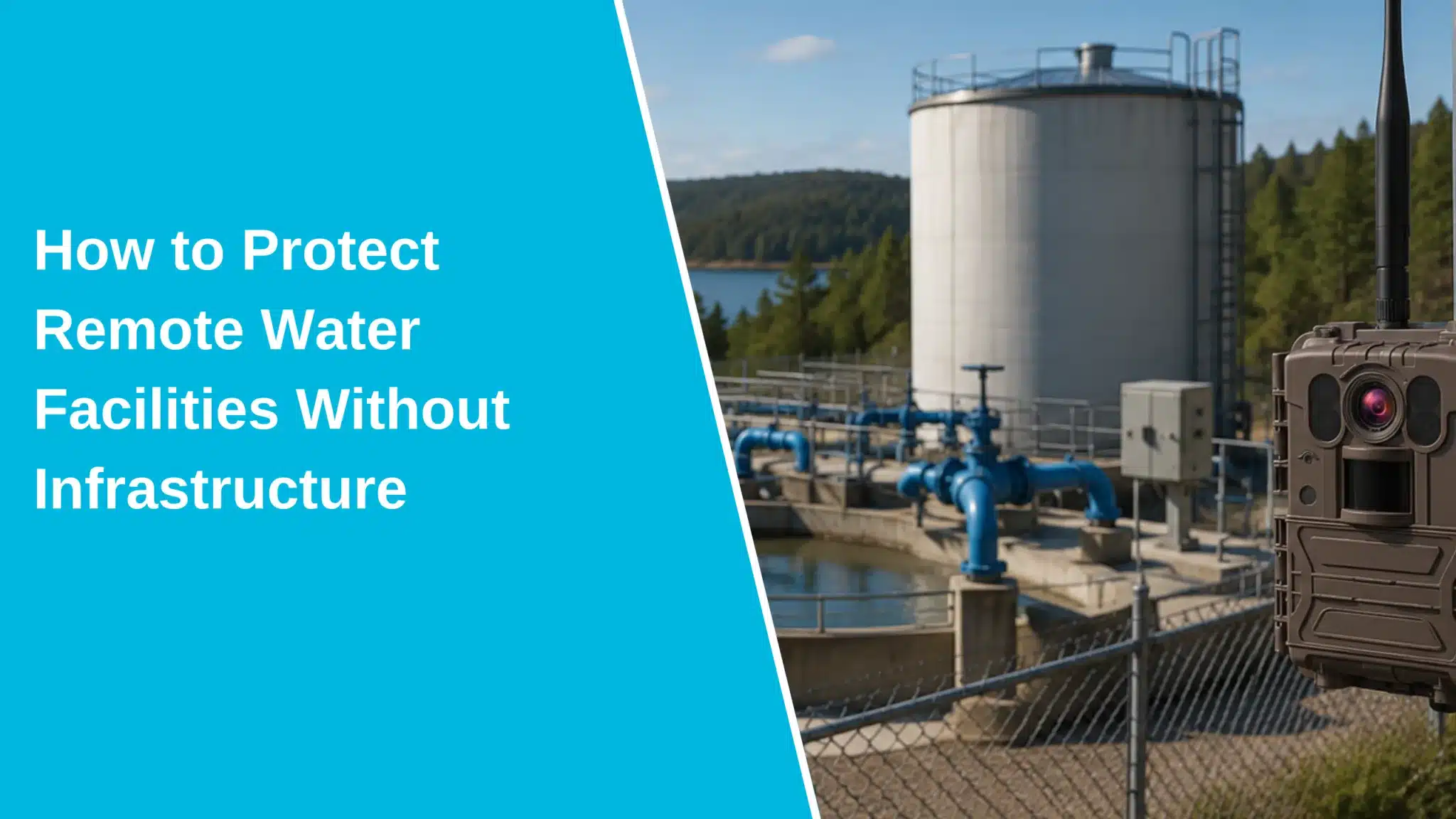
How to Protect Remote Water Facilities Without Infrastructure
How to Protect Remote Water Facilities Without Infrastructure
Remote water facilities are difficult to secure for one reason above all others: they are rarely built with security infrastructure in mind. Pumping stations, reservoirs, boreholes, valve compounds, and treatment support sites are often spread across isolated areas, with limited power, no communications backbone, and long response times. Yet these sites still protect critical assets, essential operations, and public service continuity. That is why remote water facility security requires a solution that works from day one, without depending on trenching, poles, recorders, or a full CCTV buildout.
This is exactly where we use CovertEye 4G with OutWatch. CovertEye 4G is our fully autonomous tactical camera for remote, infrastructure-free locations. It gives us 4G LTE communications, PIR and vibration-based detection, built-in GPS, encrypted communication, and flexible power options including rechargeable battery, DC 12V, and solar. When we connect it to OutWatch, we turn field detection into a complete verified-alert workflow. The camera detects the event, and OutWatch applies AI-based analysis so only verified threats are pushed to the user.
Why remote water facility security needs a different approach
Remote water infrastructure is exposed to a broad range of threats: theft of equipment, vandalism, trespassing, sabotage, illegal dumping, and unauthorized vehicle activity. The problem is not only that these sites are unattended. It is that the risk is usually spread across the site itself. Open yards, pump areas, tank surroundings, exposed equipment zones, and perimeter-adjacent space can all become part of the threat area.
That is why we do not treat CovertEye 4G as a narrow access-point camera. We use it to secure a large operational area around the asset. With a 110° field of view and PIR detection up to 25 meters, it gives us broad visual coverage around remote infrastructure instead of limiting protection to a single gate, fence corner, or approach path. For remote water facility security, that wider-area coverage is critical because threats often develop across the site, not only at a formal entrance.
Traditional CCTV is often too heavy for this environment. It assumes fixed power, stable communications, visible installation points, and ongoing infrastructure support. Fence-mounted sensors have value in some sites, but they only tell us that a perimeter element was disturbed. They do not tell us what caused the event, and they do not help when the real vulnerability is in open space around pumps, tanks, service compounds, or utility equipment. For remote water sites, we need autonomous visual detection and verified alerts, not just more hardware in the field.

How we protect remote water facilities with CovertEye 4G and OutWatch
Our model is simple and effective because it works in two steps.
Step 1: CovertEye 4G detects the event
CovertEye 4G is designed for remote, infrastructure-free deployment. We can install it quickly where coverage is needed most, without waiting for permanent security infrastructure. It supports 4G LTE communications, built-in GPS, invisible 940nm IR for night capture, PIR and vibration detection, and AES-256 encrypted communication over HTTPS. It is also ruggedized for demanding outdoor conditions, with an IP68 rating and an operating range of -20°C to 60°C.
In practice, that gives us a flexible protection layer for water infrastructure. We can monitor open ground around a pumping station, secure the operating space around reservoirs, watch equipment compounds, cover service areas near valves and controls, and protect exposed support assets without redesigning the site around the security system. That flexibility is one of the reasons CovertEye 4G is such a strong fit for remote water facility security.
Step 2: OutWatch verifies the threat
Detection alone is not enough in remote environments. If every motion event becomes an alarm, operators quickly lose confidence in the system and waste time reviewing noise. That is why OutWatch is essential.
OutWatch is our AI-powered alarm verification platform. It analyzes alarm images in real time using our proprietary AI Vision model, classifies potential threats, and filters false alarms before sending push notifications. It reduces false alerts by approximately 95% and allows users to manage all outdoor cameras from PC or smartphone. We can also define threats of interest and sensitivity levels, which makes the system far more useful than a generic motion-alert workflow.
For remote water facility security, this matters because the site may be unattended for long periods, and the response team may be covering many locations at once. Operators do not need more alarms. They need accurate alerts tied to real human, vehicle, or other defined threat activity. That is exactly what CovertEye 4G and OutWatch deliver together.
Why this is better than standard CCTV for remote water facilities
Standard CCTV often creates a mismatch between the system and the site. It can work well in connected facilities, but remote water assets usually need something faster, lighter, and more adaptable. The cost and effort of adding power, communications, recording, and remote access can outweigh the practical value of the deployment.
We solve the problem differently. CovertEye 4G is built for tactical autonomous installation, and OutWatch provides the intelligence layer that makes those detections usable. Instead of simply capturing video and leaving users to interpret it later, we create a workflow where alarms are analyzed in real time and only verified threats generate notifications. That improves response quality and reduces the operational burden of remote monitoring.
This also gives us a stronger model for distributed water infrastructure. Many operators do not have one large facility. They have multiple smaller remote assets spread across a region. OutWatch lets us manage outdoor cameras from one centralized interface, which is exactly what makes remote water facility security scalable.
Why this is better than fence-mounted sensors for small remote sites
Fence-mounted systems are useful when the perimeter itself is the best place to detect intrusion. Remote water facilities are not always that simple. Some have incomplete fencing, some include vulnerable areas outside the primary perimeter, and some are better protected by monitoring the full operating zone around the site rather than waiting for an intruder to touch the fence.
That is why CovertEye 4G is the stronger solution for this use case. We can place it to cover the area that actually matters, not just the barrier. The camera gives us broad field coverage, covert deployment, visual evidence, and reliable night capture, while OutWatch turns detection into verified alerts. For remote water facility security, this produces better awareness and more efficient response than a system that only reports disturbance at the perimeter line.
Technical specifications: CovertEye 4G + OutWatch
Specification | Detail |
Deployment type | Fully autonomous tactical camera for remote, infrastructure-free locations |
Connectivity | 4G LTE |
Detection | PIR sensor + vibration/tamper detection |
PIR detection range | Up to 25m |
IR illumination | Up to 25m, 940nm invisible IR |
Field of view | 110° (f/1.85) |
Image resolution | 5MP / 8MP / 16MP / 24MP / 32MP |
GPS | Yes, internal antenna |
Secure communication | AES-256 over HTTPS |
OutWatch integration | Yes |
Power supply | Rechargeable lithium battery pack / DC 12V / solar panel |
Memory | Up to 512GB Class 10 |
IP rating | IP68 |
Operating temperature | -20°C to 60°C |
Operating humidity | 5%–90% |
Dimensions | 130mm × 104mm × 69mm |
Weight | 400g |
Where this deployment works best in water infrastructure
We typically use CovertEye 4G + OutWatch across a range of remote utility environments. It is especially effective for pumping stations, boreholes, valve compounds, remote reservoirs, isolated equipment yards, service compounds, and temporary utility protection where a rapid tactical deployment is required. Because the system does not rely on fixed local infrastructure, we can secure the site much earlier in the project lifecycle and maintain protection even where conventional systems are impractical.
The real advantage is that we are not forced to choose between visibility and practicality. We can cover a substantial area around the facility, detect movement reliably, verify the threat with AI, and deliver alerts that are actionable from the first notification. That is the difference between installing a camera and implementing a real remote water facility security strategy.
Build remote water facility security around verified alerts
Remote water sites cannot wait for ideal infrastructure before they become secure. They need a protection model that is practical, autonomous, and reliable in the real conditions those sites operate in. That is why we pair CovertEye 4G with OutWatch.
Together, they give us wide-area remote coverage, covert deployment, secure communications, AI-based threat verification, and centralized control through a single platform. For utilities, integrators, and security managers, this is the smarter way to approach remote water facility security: protect the site early, cover the space that actually matters, and respond only to verified threats.
Talk to us about designing a CovertEye 4G + OutWatch deployment for your remote water facilities.
Frequently Asked Questions (FAQ)
What is the best way to secure a remote water facility without infrastructure?
We use an autonomous detection and verification model. CovertEye 4G delivers remote visual detection without relying on fixed infrastructure, and OutWatch verifies alarms in real time so only genuine threats generate alerts.
Why is CovertEye 4G a good fit for remote water facility security?
Because it protects a large operational area around the asset, not just a single point of entry. With a 110° field of view, up to 25 meters of PIR detection, 4G LTE connectivity, and flexible power options, it is designed for exactly the kind of remote utility environment where conventional systems are difficult to deploy.
How does OutWatch improve security performance?
OutWatch analyzes alarm images using our AI Vision model, reduces false alerts by approximately 95%, and sends push notifications only when a verified threat of interest is detected. That makes the system faster, cleaner, and far more efficient to manage.
Can CovertEye 4G operate in harsh outdoor conditions?
Yes. CovertEye 4G is rated IP68 and operates from -20°C to 60°C, which makes it well suited for remote outdoor utility sites.
Can we monitor multiple remote sites from one platform?
Yes. OutWatch gives us centralized alarm management and lets us view and manage outdoor cameras from PC or smartphone, which is ideal for utilities responsible for dispersed assets.

