
How MOSS Outdoor Improves Situational Awareness in Temporary Field Operations
How MOSS Outdoor Improves Situational Awareness in Temporary Field Operations
Temporary field operations create a very specific security challenge. A team may need to secure a stakeout, protect a temporary camp, or establish early warning around a short-term operational area, often with little time and no supporting infrastructure.
In these situations, the issue is not simply intrusion detection. The real requirement is situational awareness.
Teams need to know when activity is approaching, where it is happening, and how quickly they can assess the situation. They also need a solution that can be deployed fast, operate covertly, and move with the mission.
That is where MOSS Outdoor fits. Built for mobile and tactical applications, MOSS Outdoor delivers rapid-deployment outdoor protection through buried seismic detection, wireless alerting, and handheld situational awareness tools. It is designed for operations that require immediate protection without depending on site power or communications infrastructure.
Why temporary field operations need better early warning
Stakeouts, temporary camps, mobile deployments, and other short-term field missions often operate in open terrain, remote areas, or unsecured outdoor environments. These missions may last hours, days, or many months, but they still face the same core problem: the team needs warning before a person or vehicle gets too close.
Visible surveillance tools do not always solve that problem well. A camera may provide visual coverage, but it does not necessarily give covert early warning. A guard presence may offer observation, but it cannot create an invisible detection layer across likely approach paths. And infrastructure-heavy systems are often too slow or too cumbersome to deploy when the mission is temporary.
What field teams need is a solution that can create a covert detection layer quickly, report the location of the intrusion, and support faster decision-making from a safer position.
That is the role of MOSS Outdoor.

A security model built for mobility
MOSS Outdoor is designed for temporary and mission-driven deployments where flexibility matters more than fixed infrastructure. The system is based on AIO 2.0 autonomous wireless seismic sensors, a wireless smartphone receiver, and a rugged smartphone running SG-Patrol.
Each sensor is battery powered and communicates wirelessly, creating a private secured network without requiring power lines, communication cables, or permanent installation work. That makes the system especially relevant for missions where teams need to deploy quickly, remain mobile, and avoid leaving a visible footprint in the field.
Installation can be completed in minutes, which is a major operational advantage in temporary field environments.
How MOSS Outdoor works in practice
The concept is straightforward.
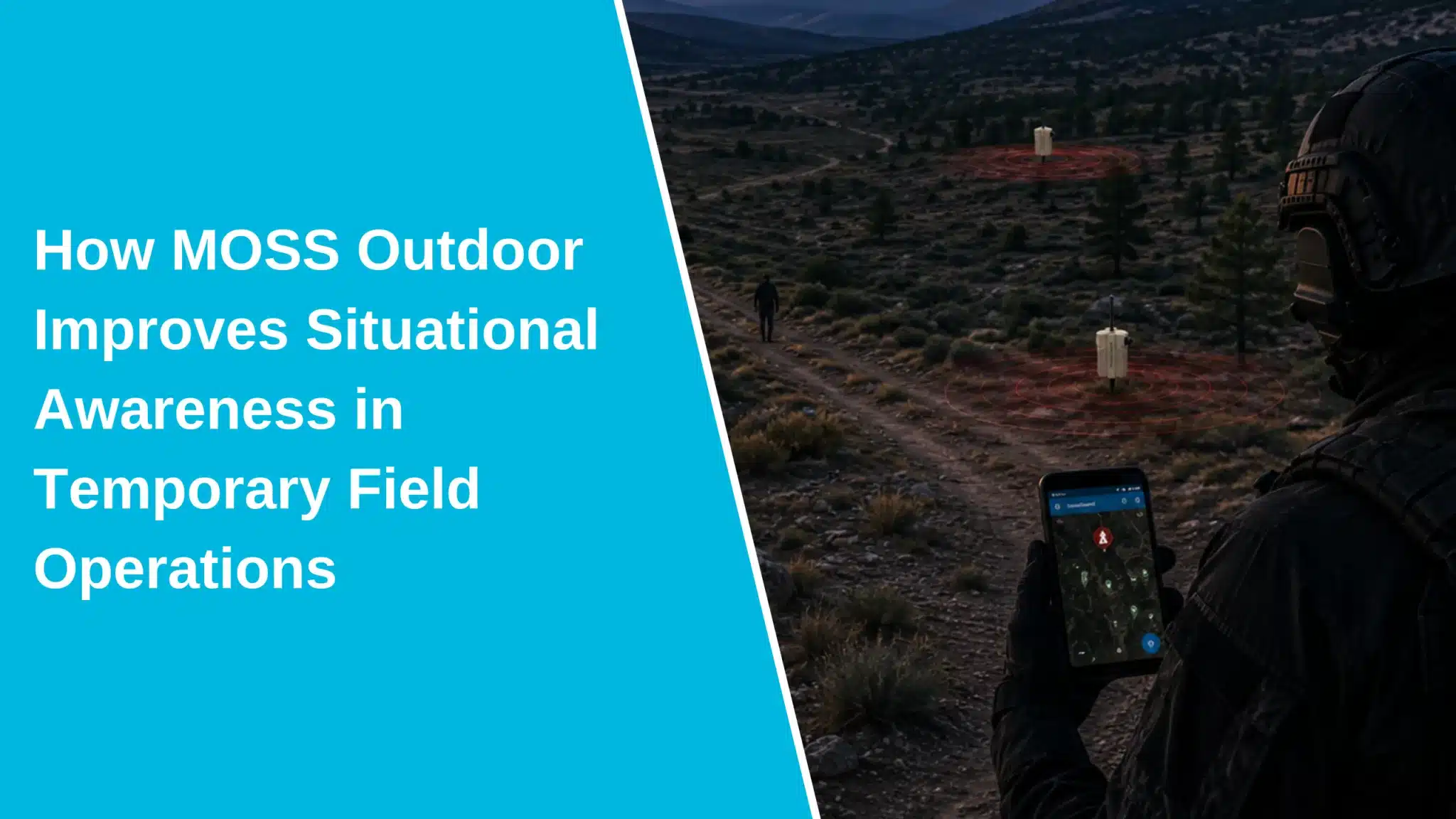
Buried AIO 2.0 seismic sensors are placed at likely approach paths, access points, or points of interest. When a sensor detects activity, it sends a wireless alert through the smartphone receiver to the SG-Patrol App on the rugged handheld device. The team receives an audible alarm together with the location and type of alert in real time.
This moves the system beyond a simple alarm function. Instead of only knowing that something happened, the operator gains immediate awareness of where the event occurred and what kind of intrusion has been detected.
That is why MOSS Outdoor is best understood as a tool for field situational awareness.
The SG-Patrol interface supports this workflow by displaying sensor locations and alarm notifications on a map-based view, giving teams a more useful picture of what is happening around the temporary operating area.
Detection capabilities that support temporary outdoor missions
For outdoor field protection, MOSS Outdoor uses AIO 2.0 sensors that provide 360° coverage and support detection of footsteps, vehicles, and digging activity.
AIO2 Specifications:
Capability | MOSS Outdoor / AIO 2.0 |
Human footsteps detection | Up to 18 m / 60 ft radius |
Vehicle detection | Up to 35 m / 115 ft radius |
Digging detection | Up to 35 m / 115 ft radius |
Coverage | 360° |
Battery life | Up to 1 year, rechargeable |
Transmission range | Up to 250 m buried / up to 1 km with antenna above ground |
Environmental protection | IP68, MIL-STD 810G |
These characteristics are important because temporary field missions often require more than portability. They require ruggedness, endurance, and the ability to operate in demanding outdoor environments without continuous support.
Improving situational awareness, not just alerting
A temporary mission benefits from more than a sensor trip notification. It benefits from a workflow that helps the team understand what is developing around them.
MOSS Outdoor supports that workflow in three steps:
- Detection through buried AIO 2.0 seismic sensors
- Alert delivery to the wireless receiver and in parallel to the rugged smartphone running SG-Patrol
- Assessment by the team using the alert type, sensor location, and operational context
For missions that require an added verification layer, MOSS Outdoor can also be configured with an optional PTZ-based video layer. This allows teams to complement seismic alerting and handheld situational awareness with immediate visual confirmation of the intrusion area.
That option is especially useful when the mission profile requires both covert early warning and faster remote verification.
Best-fit use cases for MOSS Outdoor
MOSS Outdoor is most effective where the requirement is temporary protection, rapid deployment, and improved awareness in the field.
Stakeouts and covert observation
Stakeout missions depend on discretion and timing. A visible security setup may undermine the operation, while a late alert may reduce the team’s response options. Buried seismic sensors placed on likely approach routes can provide earlier warning while allowing the team to remain at a safer and more concealed position.
Temporary camps
Temporary camps often need protection quickly, without building a fixed perimeter security system. MOSS Outdoor provides a covert detection layer around likely access points and helps the team maintain awareness of movement near the camp boundary.
Mobile field missions
When teams are moving between locations or protecting changing areas of interest, the ability to redeploy quickly matters. MOSS Outdoor supports this need with a modular, infrastructure-light architecture that can move with the mission instead of anchoring the operation to a permanent site.
Critical approach paths and access points
Field missions often have predictable avenues of approach: tracks, dirt roads, paths, open corridors, or service routes. Positioning seismic sensors at these points helps teams receive earlier notification before contact is made near the protected activity or operating area.
VIP and temporary outdoor event security
In temporary outdoor protection missions, teams may need a covert and mobile way to monitor likely approaches without creating a large visible footprint. MOSS Outdoor supports this with buried detection, rapid setup, and real-time alerting on a handheld device.
Why conventional security is often the wrong fit
For temporary field operations, conventional outdoor security systems can be too rigid.
A fixed CCTV setup may offer live viewing, but it often assumes power, mounting infrastructure, communications, and enough time for installation. That may work for permanent sites, but it is not always practical for a temporary field mission.
Guard-only coverage offers flexibility, but it has no covert seismic layer and depends entirely on human observation.
MOSS Outdoor fills the gap between those two approaches. It provides:
- covert detection
- fast deployment
- operation without infrastructure
- location-based alerts to the field team
- modular expansion depending on mission needs
- optional video verification when required
That makes it a better fit for mobile and temporary operations where awareness, mobility, and response speed matter more than permanent infrastructure.
Comparison: fixed surveillance vs guard-only coverage vs MOSS Outdoor
Criteria | Fixed CCTV / mast-based setup | Guard-only coverage | MOSS Outdoor |
Deployment speed | Slower, setup-intensive | Fast | Fast, installs in minutes |
Infrastructure dependency | Usually high | Low | None required for core operation |
Covert operation | Limited | Limited | Strong, buried seismic detection |
Early warning before contact | Depends on view and monitoring | Depends on personnel | Yes |
Alert delivery to field team | Often indirect | Manual | Real-time via wireless receiver and SG-Patrol |
Redeployability | Lower | High | High |
Suitability for temporary missions | Moderate | Moderate | High |
Optional video verification | Yes, but infrastructure-heavy | Manual only | Yes, as an added mission-specific layer |
What decision-makers should look for
When selecting a solution for temporary field operations, the right evaluation criteria are not the same as for long-term infrastructure security.
Decision-makers should focus on whether the system can:
- operate without site power and communications
- provide covert early warning
- deliver alerts directly to the team in the field
- improve awareness with location-based alarm reporting
- be deployed and redeployed quickly
- support optional visual verification where the mission requires it
MOSS Outdoor meets those requirements with a modular architecture that can be adapted to different field scenarios and operational priorities.
Conclusion
Temporary field operations require a different kind of security thinking. The objective is not to build a permanent perimeter. It is to create awareness quickly, covertly, and with as little infrastructure burden as possible.
MOSS Outdoor answers that need with a practical combination of buried seismic detection, wireless alerting, SG-Patrol handheld awareness, and optional video verification for missions that require an additional layer of assessment.
For stakeouts, camps, and mobile field missions, that means earlier warning, better awareness, and a security approach that moves with the operation rather than slowing it down.
To explore the right MOSS Outdoor configuration for your mission profile, contact us to discuss sensor layout, alerting workflow, and optional verification layers.
Frequently Asked Questions (FAQ)
What is MOSS Outdoor designed for?
MOSS Outdoor is designed for temporary field operations that require rapid deployment, covert detection, and real-time alerts without relying on fixed power or communications infrastructure.
How do operators receive alarms?
Alarms are sent from the AIO 2.0 sensor to the wireless receiver and to the rugged smartphone running SG-Patrol, allowing the team to receive audible alerts together with the location and type of alarm.
What kinds of activity can the system detect?
MOSS Outdoor detects human footsteps, vehicles, and digging activity using buried seismic sensors with 360° coverage.
Is MOSS Outdoor intended for permanent infrastructure protection?
No. MOSS Outdoor is best suited to mobile, temporary, and mission-driven protection rather than fixed long-term site security.
Can MOSS Outdoor include video verification?
Yes. For relevant missions, an optional PTZ-based verification video layer can be added to complement the seismic alerting and handheld situational awareness workflow.

