
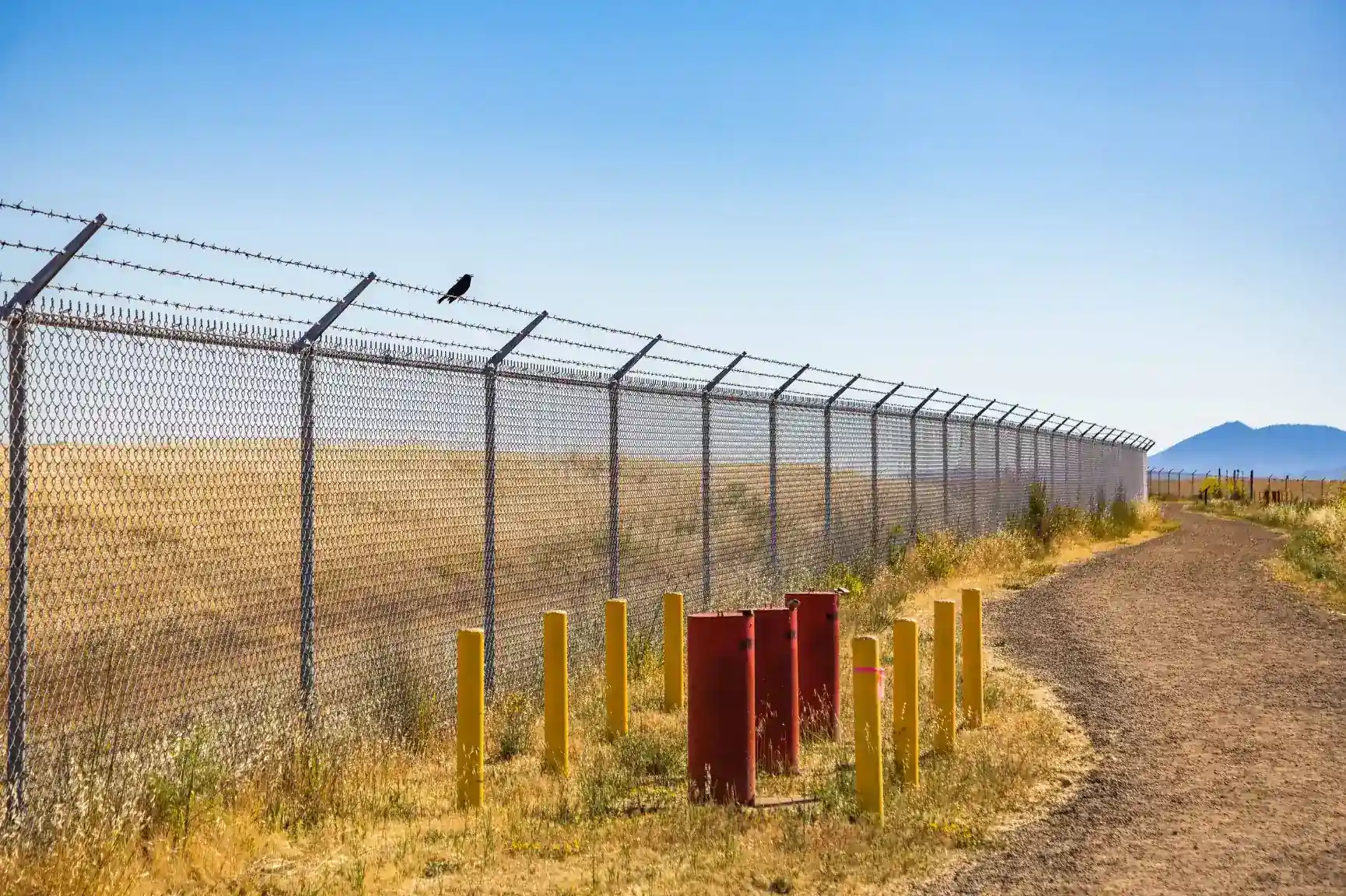
A Perimeter Intrusion Detection System (PIDS) is a security system designed to monitor and protect the perimeter of a property or site. It detects unauthorized attempts to breach the barriers. PIDS can be used in a variety of applications, including protecting industrial complexes, agricultural areas, and high-security sites like government facilities and military installations.
Traditional PIDS often rely on technologies like infrared sensors, motion detectors, or video surveillance. However, seismic sensors have emerged as a game-changing option, offering a more advanced, accurate and invisible approach to perimeter security.
How Does PIDS Work?
PIDS typically use a combination of sensors that are strategically placed along or around the perimeter. Each technology detects a different physical signature of an intrusion attempt, such as ground vibration, a broken light path, a change in an electromagnetic field, or motion in a camera frame, and reports it to a central system for analysis. The key to a successful PIDS is the ability to reduce nuisance and false alarms while still providing real-time alerts the moment an actual breach occurs.
Types of PIDS Technologies
There's no single "best" PIDS technology; the right choice depends on perimeter length, terrain, budget, and how visible the security measures are allowed to be. Here's how the main categories compare at a glance, with a detailed breakdown of each below.
| Criteria | Buried / Underground | Fence-Mounted | Free-Standing (IR / Microwave) | Video Analytics |
|---|---|---|---|---|
| Visibility to intruders | Fully concealed, nothing visible above grade | Visible on the fence line | Visible posts, beam path, or radar unit | Visible cameras |
| Requires existing infrastructure | No, but requires trenching | Yes, an existing or purpose-built fence | No, but needs a clear line of sight | Yes, cameras |
| Weather resilience | Strong for seismic; fiber/coax need stable, dry soil conditions | Sensitive to wind-driven fence vibration | Degraded by fog, heavy rain, or snow | Degraded at night or in poor weather |
| Typical false-alarm sources | Minimal for seismic; standing water or snow for leaky coax | Wind, animals, debris hitting the fence | Birds, foliage, dust, beam misalignment | Lighting changes, small animals, fixed field of view |
| Install complexity | Trenching required; fiber and coax need precise burial depth | Faster to retrofit onto an existing fence | Moderate, needs clear sightline planning | Easiest if cameras already exist on site |
| Defeat resistance | Hard to locate or study since it's hidden | Can be bridged or climbed between sensors | Detection zone is mappable; can be crawled under or jumped | Detection point is visible at the lens |
Buried / Underground Sensors
Buried systems detect intrusions from underground, so nothing is visible above grade. The three main buried technologies are:
- Seismic sensors detect and locate intrusions by sensing vibrations in the ground caused by footsteps, digging, or vehicle movement. Installation depth is flexible (typically 30cm–3m without a performance penalty), and the sensors are largely unaffected by weather, standing water, or nearby metal objects.
- Fiber optic cable uses a central controller that sends pulses of light through a buried fiber and analyzes the reflections to detect and locate disturbances. It scales well over very long runs (a single controller can cover tens of kilometers) but installation depth accuracy is critical, typically within about 20cm, and burying it too deep or too shallow measurably degrades performance.
- Leaky coax cable creates a buried electromagnetic detection field; a controller monitors that field for the disturbance caused by an intruder crossing it. Like fiber, it needs precise installation depth (roughly 23cm) and must be kept away from metal objects such as fences or pipes, and standing water or snow above the cable can cause false alarms.
All three require trenching, but they differ meaningfully on cost curve, maintenance complexity, and burial-depth tolerance — see our full underground sensor technology comparison for a side-by-side breakdown of installation, maintenance, and cost by perimeter length.
Fence-Mounted Sensors
Fence-mounted systems attach directly to an existing or purpose-built fence line and detect the vibration, strain, or electrical disturbance caused by someone climbing, cutting, or shaking the fence. Common variants include vibration/shaker sensors, taut-wire sensors woven through the fence fabric, and electrified fence lines. They're generally faster to retrofit onto an existing fence than a buried system, but detection quality is tied directly to fence condition, and wind-driven fence vibration is a common source of nuisance alarms.
Free-Standing / Line-of-Sight Systems
These systems don't need a fence or buried cable at all. Active infrared (IR) beams create an invisible detection line between a transmitter and receiver; breaking the beam triggers an alarm. Microwave and radar-based systems instead project a volumetric detection field across open ground and flag movement within it. Both require a clear, unobstructed line of sight, so they perform poorly around vegetation, uneven terrain, fog, or heavy rain, and their detection zone is visible and mappable by anyone studying the site.
Video Analytics (VMD)
Video motion detection analyzes camera feeds directly for movement or, in more advanced systems, for object classification (person vs. vehicle vs. animal). It's the easiest technology to add to a site that already has cameras, but as a standalone perimeter layer it inherits every limitation of the cameras themselves: fixed field of view, degraded performance at night or in poor weather, and a detection point that's exactly where the intruder can already see the lens.
How PIDS Performance Is Measured
Independent of which technology a site chooses, security teams generally evaluate a PIDS against the same handful of criteria:
- Probability of detection (Pd): how reliably the system catches a genuine intrusion attempt across its coverage area, including at the edges of a detection zone.
- Nuisance and false alarm rate (NAR/FAR): how often the system alarms on something that isn't a real threat, wind, wildlife, weather, or a passing vehicle outside the protected area. A system with a high Pd but a high FAR still fails in practice, because operators start ignoring alerts.
- Vulnerability to defeat: how hard the system is to identify, avoid, or physically bypass once an intruder knows it's there. Visible systems (fences, IR beams, above-ground cameras) are inherently easier to study and route around than concealed ones.
- Environmental resilience: whether performance holds up in rain, wind, fog, extreme temperature, and seasonal changes like new vegetation growth, without constant recalibration.
Choosing the Right PIDS for Your Site
In practice, the decision usually comes down to a few site-specific questions: How long is the perimeter, and does cost scale linearly with distance for the technology in question? Is the terrain open and clear, or does it have vegetation, slopes, or obstructions that rule out line-of-sight systems? Does the site need the security layer to stay invisible (a residential property, a historic site) or is a visible deterrent acceptable or even preferred (a construction site, a temporary perimeter)? And how much ongoing maintenance and recalibration can the operations team realistically support? Answering these narrows the field considerably before ever comparing specific vendors.
Why Seismic Shield Pro is a Game-Changer in PIDS
Among the various types of sensors, seismic sensors have proven to be particularly valuable for perimeter security, and Seismic Shield Pro by SensoGuard is at the forefront of this innovation.
Key Features of Seismic Shield Pro
- Real-Time Detection and Alerts: Seismic Shield Pro uses advanced seismic sensing technology to detect ground vibrations in real time. Whether it's a human or vehicle moving along the perimeter, the system instantly triggers an alert, allowing security teams to respond quickly.
- Integrated 2-Layer Intruder Verification: Seismic Shield Pro is fully integrated with IDIS AI analytics PTZ cameras, creating a powerful two-layer verification system. When a seismic event is detected, the system automatically directs the nearest PTZ camera to the event location. The built-in AI-based video analytics then verifies whether the cause is a real intrusion. The camera keeps track of the intruder automatically. This smart verification drastically reduces false alarms and ensures that only true threats trigger alerts.
- Invisible, Underground Protection: One of the most significant advantages of Seismic Shield Pro is its ability to offer invisible protection. The sensors are buried underground, which not only makes them difficult for intruders to detect, but also maintains the aesthetic integrity of the property.
- Scalability and Flexibility: Seismic Shield Pro is highly scalable and can be customized to match the specific layout of the protected site. It is suitable for infrastructure sites, borders, prisons, and large government facilities.
Benefits of Using Seismic Shield Pro in PIDS
Seismic Shield Pro is not just another sensor, it's a leap forward in perimeter security. Here's why it should be considered for your PIDS:
- Early Detection: Detects intrusion attempts before the intruder even reaches the fence or boundary. Ideal for securing wide perimeters where early intervention is critical.
- Drastically Reduced False Alarms: The built-in 2-layer verification, seismic detection + AI video verification eliminates up to 95% of false alarms, ensuring that security teams are only alerted to genuine threats.
-
Highly Cost-Effective: Seismic Shield Pro offers significant cost savings compared to traditional fence-mounted or camera-only systems:
- Fewer cameras needed: Thanks to precise location reporting, a single PTZ camera can cover large zones, reducing the total number of cameras required.
- Minimal maintenance: With no moving parts and underground placement, seismic sensors are highly durable and require little maintenance.
- Non-Invasive and Covert: The underground installation makes it nearly impossible to detect or sabotage.
Frequently Asked Questions
What does PIDS stand for?
PIDS stands for Perimeter Intrusion Detection System — a security system designed to monitor and protect the perimeter of a property or site, detecting unauthorized attempts to breach the boundary before an intruder reaches the interior.
What's the difference between PIDS and a standard alarm system?
A standard alarm system — door and window sensors, interior motion detectors — typically triggers only after an intruder has already entered a building. PIDS is designed to detect an intrusion attempt at the perimeter itself, ground vibration, a broken beam, fence movement, or motion in a camera frame, giving security teams a warning before the boundary is actually breached.
Which PIDS technology has the lowest false alarm rate?
It depends on site conditions, but buried seismic sensors are generally the most resistant to environmental false alarms since they're unaffected by wind and fog, unlike fence-mounted sensors (wind-driven vibration) or free-standing IR and microwave systems (birds, foliage, weather). Reducing nuisance and false alarms while still catching real intrusions is the core engineering challenge behind any PIDS.
Can PIDS be combined with video cameras?
Yes, this is a common and effective approach. PIDS acts as the detection layer, alerting security teams the moment an intrusion attempt occurs, while cameras, often AI-enabled PTZ cameras, provide visual verification of the event. This two-layer combination significantly reduces false alarms compared to using either technology alone.
How is PIDS performance measured?
Security teams generally evaluate PIDS against four criteria: probability of detection (how reliably it catches genuine intrusions), nuisance and false alarm rate (how often it alarms on non-threats), vulnerability to defeat (how easily an intruder can identify and bypass it), and environmental resilience (whether performance holds up in rain, wind, fog, and seasonal changes).