
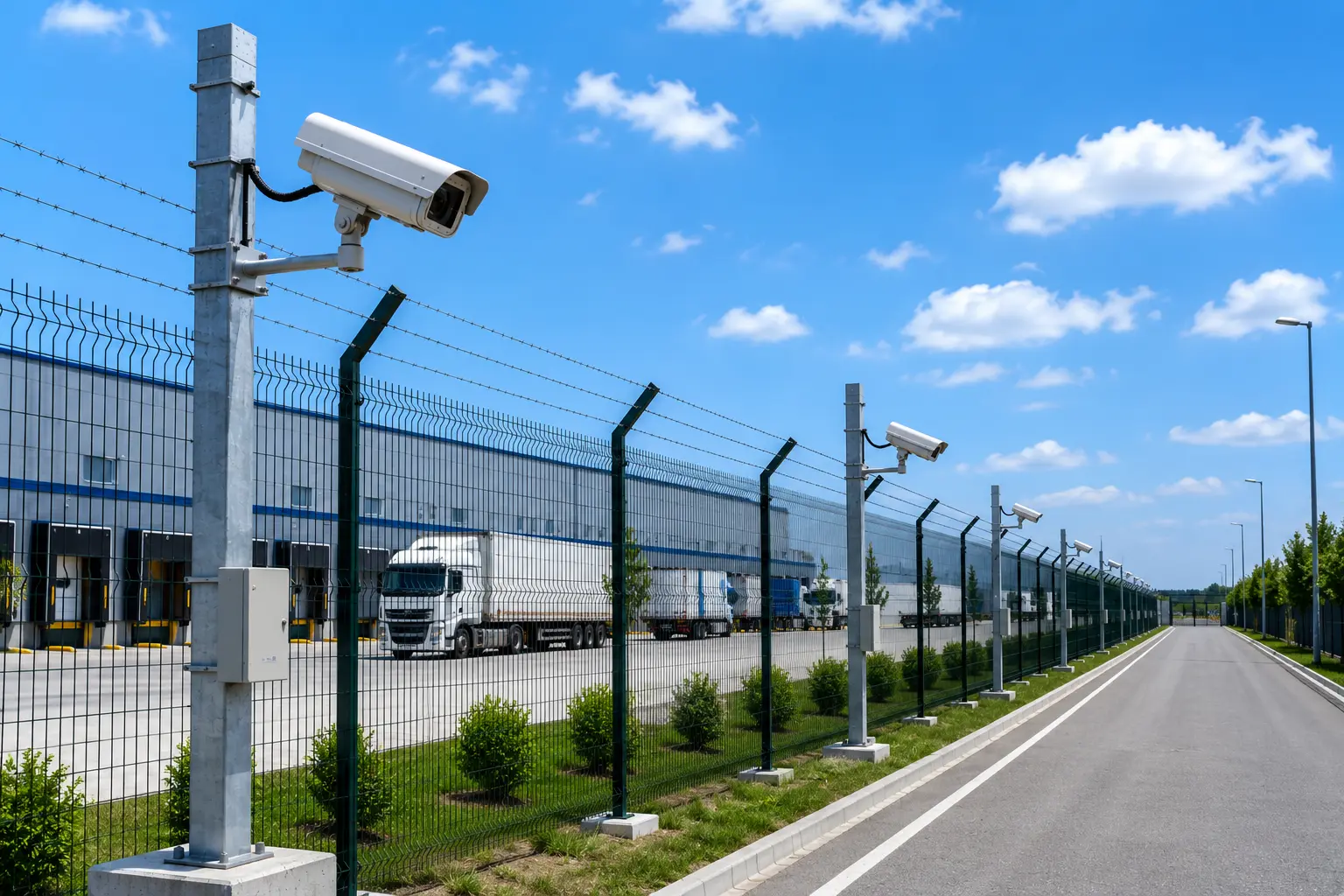
CCTV looks like the simple answer to perimeter security: install cameras along the fence, monitor the feed, respond to activity. But cameras are usually the smallest line item in the budget. Infrastructure, storage, network capacity, software licensing, and maintenance add up fast, and on a long perimeter, they typically cost far more than the cameras themselves.
This is a real problem at solar farms, industrial plants, airports, logistics hubs, and other critical infrastructure sites, where fence lines can run for kilometers. Understanding where those costs actually come from is the first step toward a perimeter architecture that stays effective without becoming a runaway budget line.
The Camera Density Problem
Fixed cameras such as bullet or dome cameras have a limited field of view. To maintain continuous coverage along a fence line, they are typically installed every 30 to 40 meters. On a long perimeter, that spacing multiplies quickly:
- A 2 km perimeter may require 50 to 70 cameras
- A 5 km perimeter may require more than 120 cameras
- Very large industrial sites may require hundreds of cameras
Every additional camera adds installation cost, and every camera added after that adds ongoing operational cost too.
Infrastructure Requirements
Every one of those cameras needs supporting infrastructure to actually operate: mounting poles, electrical power, fiber or wireless communication links, network switches, and a central monitoring and recording system. For remote facilities without existing power or network runs, building that infrastructure can represent a major share of the total project cost, and in many projects it exceeds the price of the cameras themselves.
Video Storage and Server Requirements
Every camera continuously generates video that the video management system (VMS) has to store and process. As camera count climbs, so does the data volume, which means larger HDD or SSD storage arrays, more powerful recording servers, and more processing capacity for video analytics. High-resolution cameras recording around the clock generate substantial data, and retention requirements of weeks or months multiply that further.
Network Infrastructure and Bandwidth
Every camera also has to get its video stream back to a recording server or monitoring station. Across dozens or hundreds of cameras, that means high aggregate bandwidth, reliable long-distance communication links, and enough network switches and fiber runs to carry it all. Expanding that capacity adds both upfront installation cost and long-term maintenance complexity.
Video Management System Licensing
Many VMS platforms license per camera, so software cost scales directly with camera count. Beyond camera licenses, organizations may also pay for server licenses, video analytics licenses, and ongoing software maintenance and support subscriptions. On a system with hundreds of cameras, these recurring costs compound year over year.
Maintenance and Operational Costs
Outdoor cameras are exposed to dust, rain, wind, and extreme temperatures. At sites like solar farms or construction areas, dust accumulation alone can degrade image quality and require regular lens cleaning. Maintenance teams also need to routinely inspect camera housings, power supplies, communication cables, and network infrastructure, work that scales directly with how many cameras are in the field.
False Alarm Investigations
Camera systems that rely on video analytics can also generate frequent false alarms from animals near the perimeter, wind-driven vegetation, lighting changes, and shadows. Every one of those alarms has to be investigated by an operator to determine whether it's a real threat, and for remote sites, false alarms can trigger unnecessary dispatch of security personnel, adding operational cost on top of everything else.
Limited Detection and Situational Awareness
The deeper limitation of camera-only perimeter security is timing. A camera only detects an intruder once they enter its field of view, which in many cases means detection happens after the perimeter has already been crossed. Fixed cameras also only cover a limited section of the fence line; if an intruder moves outside that section, operators lose visibility of the event until it reappears in another camera's frame, if it does at all.
A Smarter Architecture: Sensors and PTZ Verification
Modern perimeter security increasingly pairs sensor-driven detection with intelligent cameras instead of relying on cameras to detect intrusions on their own. Seismic perimeter sensors detect the ground vibration created by footsteps, vehicles, or digging activity. When that activity is detected, the system automatically directs a PTZ camera to the exact location of the intrusion, so the camera's job shifts from constant scanning to targeted verification. That's the model behind Seismic Shield Pro, which pairs buried seismic sensors with a PTZ camera and built-in AI video analytics for exactly this workflow.
Continuous Tracking of Intruders
Once an alarm is verified, a PTZ camera can automatically follow the intruder using its own tracking analytics, something a row of fixed bullet cameras, each covering only its own narrow section, can't do on its own. That gives operators continuous visibility of the intruder's movement across the site, gives security teams clear visual evidence to work with, and gives response teams a chance to assess the situation before they intervene.
Fewer Cameras, Lower Infrastructure Costs
Because a PTZ camera guided by intrusion sensors doesn't need to watch a fixed 30 to 40 meter section continuously, one camera can cover far more ground. A single PTZ camera integrated with a seismic detection system can cover roughly 460 meters of perimeter, which can cut the number of cameras required by more than 90 percent compared to a traditional fixed-camera layout.
| Perimeter length | Fixed cameras (30–40m spacing) | PTZ cameras (sensor-guided, ~460m coverage) |
|---|---|---|
| 2 km | 50–70 | ~4–5 |
| 5 km | 120+ | ~11 |
Fewer cameras means less of everything else built to support them: less infrastructure, smaller storage systems, lighter network bandwidth, fewer VMS licenses, and less routine maintenance.
Lower Total Cost of Ownership
Organizations evaluating perimeter security often anchor on the price of the cameras themselves. But total cost of ownership includes installation infrastructure, video storage, server capacity, network bandwidth, software licensing, and ongoing maintenance and operations. Reducing camera count by relying on sensor-driven detection lowers every one of those line items at once, not just the hardware bill.
Designing Modern Perimeter Security
Cameras remain an essential part of a modern security system, but relying on them alone for detection creates unnecessary complexity and expense. A more effective architecture combines intrusion detection sensors for early warning, PTZ cameras for visual verification and tracking, and a centralized monitoring platform to manage it all from one operational picture. That combination protects large sites with less hardware, better situational awareness, and meaningfully lower operating costs than a camera-only design. See our comprehensive comparison of perimeter security systems for how this stacks up against fence-mounted sensors and IR beams.
Frequently Asked Questions
Why do CCTV perimeter systems require many cameras?
Fixed cameras such as bullet or dome cameras have limited fields of view, so they typically need to be installed every 30 to 40 meters to maintain continuous coverage along a perimeter. On a multi-kilometer site, that spacing alone can require dozens to hundreds of cameras.
What are the hidden costs of CCTV perimeter systems?
Hidden costs include camera poles and power infrastructure, video storage and server capacity, network bandwidth, per-camera VMS licensing, ongoing maintenance in outdoor conditions, and the operational cost of investigating false alarms.
How can perimeter security systems reduce camera requirements?
By combining intrusion detection sensors with PTZ cameras, a system can detect activity first and use the camera only to verify and track the event. That lets one PTZ camera cover far more perimeter than a row of fixed cameras spaced every 30 to 40 meters.
Why is PTZ tracking important for perimeter security?
Once a sensor verifies an alarm, a PTZ camera can automatically follow the intruder using built-in tracking analytics. That lets operators monitor movement across the site, collect clear visual evidence, and assess the situation before a response team intervenes.