
The Growing Need for Advanced Perimeter Security
Protecting large facilities and critical infrastructure has become increasingly complex. Sites such as solar farms, airports, data centers, military installations, and industrial facilities often span large areas and operate in environments where traditional security methods struggle to provide reliable protection.
Many of these facilities are located in remote or semi-remote locations, where security personnel cannot constantly monitor the perimeter. At the same time, valuable equipment and infrastructure make these sites attractive targets for theft, sabotage, and unauthorized access.
Traditional security technologies such as cameras, fence-mounted sensors, and motion detectors are often used to protect these facilities. However, these systems frequently provide limited detection capability and require significant infrastructure, making them less effective for large or remote installations.
To address these challenges, security professionals are increasingly turning to Seismic Perimeter Intrusion Detection systems, which provide invisible, early detection of intruders approaching protected areas. See our full guide to Perimeter Intrusion Detection Systems (PIDS) for how seismic detection compares to other PIDS technologies.
Limitations of Traditional Perimeter Security Systems
Many conventional perimeter security systems rely on visible infrastructure, which can create operational and security limitations.
Camera-Based Perimeter Surveillance
CCTV systems are commonly used for perimeter monitoring. However, large sites require a high number of cameras to achieve adequate coverage.
This creates several challenges:
- Cameras require power, poles, and communication infrastructure
- Dust, weather, and lighting conditions affect performance
- Cameras often detect intruders only after they enter the protected area
In addition, camera-based systems may generate false alarms triggered by wildlife, moving vegetation, or changing lighting conditions.
Fence-Mounted Intrusion Detection Systems
Another common approach is the use of fence-mounted sensors.
These systems detect events such as cutting the fence, climbing the fence, and vibration on the fence structure.
While these systems can detect certain intrusion attempts, they essentially protect the fence itself rather than the surrounding area.
This creates potential vulnerabilities. Intruders may bypass these systems by jumping over the fence without touching it, digging under the fence, or approaching and scouting the perimeter before attempting entry.
Because detection occurs only when the fence is disturbed, security teams may receive alerts too late to prevent an intrusion.
What Is Seismic Perimeter Intrusion Detection?
Seismic Perimeter Intrusion Detection is an advanced security technology that detects ground vibrations generated by human activity.
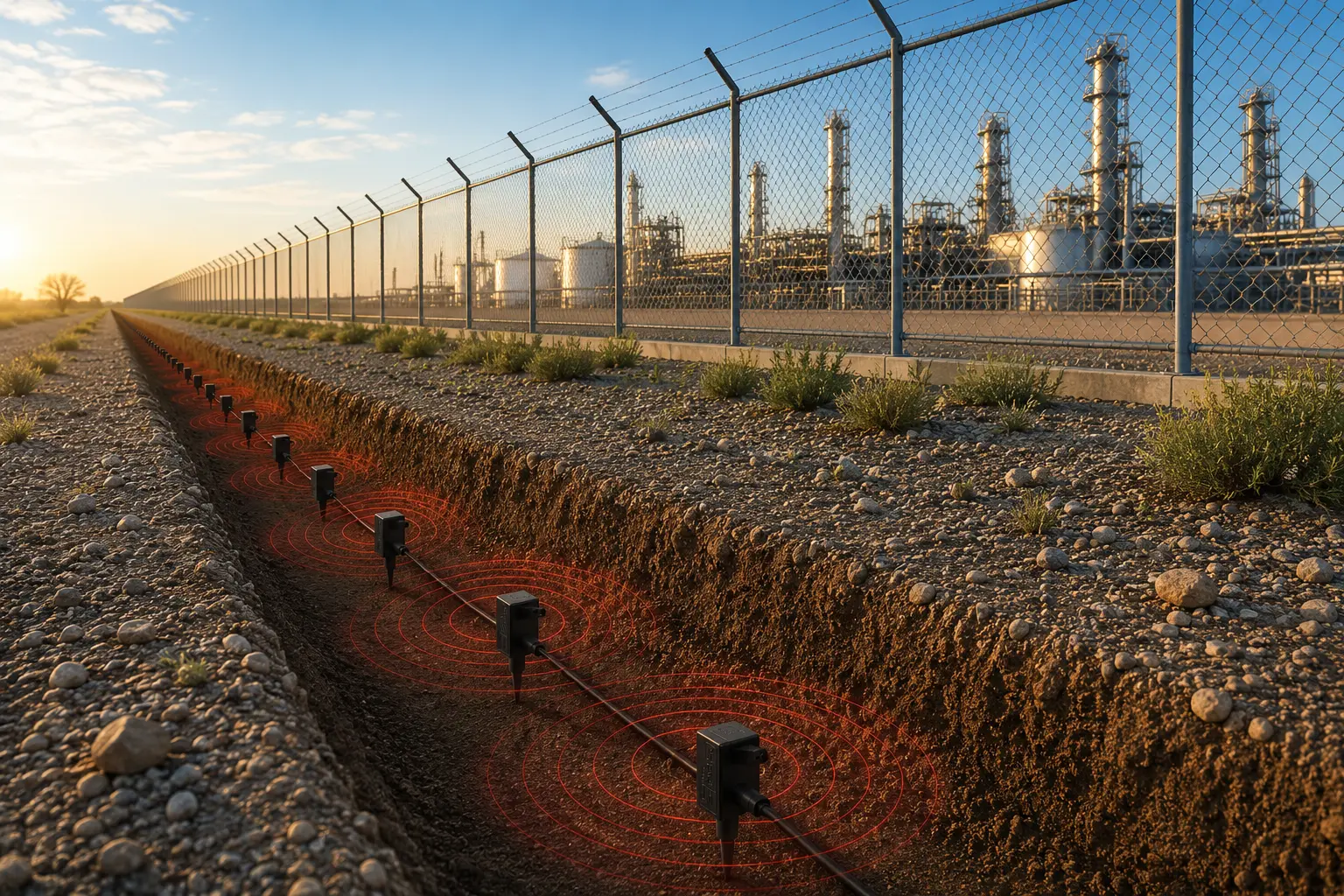
These systems use buried seismic sensors installed along the perimeter of a protected site. The sensors continuously monitor ground vibrations caused by footsteps, vehicles, digging activity, and heavy equipment movement.
When the system detects vibration patterns that match human or vehicle movement, it generates an alert and provides the location of the event.
Because the sensors are installed underground, the detection system is completely invisible to intruders, making it extremely difficult to locate, tamper with, or bypass.
Area Protection vs. Fence Protection
A key advantage of seismic detection systems is that they provide area protection rather than fence protection.
Traditional fence-mounted sensors monitor only the physical fence structure. In contrast, seismic systems protect the ground area surrounding the perimeter.
For example, seismic detection systems such as InvisiFence Plus create a detection zone that extends approximately 6 meters in width by up to 25 meters in depth along the perimeter.
This means the system can detect people approaching the fence, individuals walking along the perimeter, attempts to dig under the fence, attempts to jump or climb over the fence, and vehicles approaching restricted areas.
Because the system protects the area around the perimeter, intruders cannot bypass detection simply by avoiding contact with the fence.
How Seismic Sensors Detect Intruders
Seismic sensors are designed to identify specific vibration signatures associated with human activity.
When a person walks, each footstep produces a small ground vibration. Vehicles and digging activity also generate distinctive vibration patterns.
Advanced signal processing algorithms analyze these vibrations to distinguish between human footsteps, vehicle movement, and environmental noise.
This filtering capability helps reduce false alarms while maintaining high detection accuracy. The system can also provide precise location data, allowing security teams to identify exactly where an intrusion attempt is occurring.
InvisiFence Plus: Seismic Perimeter Intrusion Detection Technology
One example of modern seismic perimeter detection technology is the InvisiFence Plus system, which forms the detection layer of the Seismic Shield Pro security solution.
InvisiFence Plus uses buried seismic sensor cables installed along the perimeter of the protected site.
Because the sensors are installed underground, the system offers several advantages: completely invisible detection infrastructure, extremely difficult to vandalize or sabotage, protection of the entire perimeter area rather than just the fence, and early detection of suspicious activity before intrusion.
This approach provides security teams with valuable early warning capabilities.
Intelligent Verification with AI PTZ Cameras
While seismic sensors provide early detection, visual verification is essential for confirming intrusion events.
Seismic Shield Pro integrates the IDIS 4MP PTZ camera with built-in deep learning analytics and automatic tracking.
When the seismic system detects an intrusion, the PTZ camera automatically moves to the detection location. The camera then provides immediate visual verification of the event.
Once the target is identified, the camera's AI tracking capability automatically follows the intruder, allowing operators to monitor movement across the site.
This combination of seismic detection and intelligent camera tracking provides security teams with better situational awareness and supports more effective incident investigation.
Reduced Camera Infrastructure
One of the key benefits of seismic perimeter intrusion detection is the ability to reduce the number of cameras required to protect large sites.
Traditional CCTV perimeter systems often require fixed cameras every 30 to 40 meters along the fence line.
In contrast, seismic detection combined with PTZ verification allows operators to deploy a single PTZ camera approximately every 400 to 460 meters, in line with the camera's 400m infrared detection range. This represents less than 10% of the number of cameras required by traditional CCTV-based perimeter security systems.
Reducing the number of cameras significantly lowers infrastructure requirements, installation costs, and maintenance workload.
Applications of Seismic Perimeter Intrusion Detection
Seismic perimeter detection systems are particularly well suited for large or remote facilities where traditional security systems are difficult to deploy.
Common applications include solar farms, airports, data centers, military installations, oil and gas facilities, critical infrastructure sites, and remote industrial facilities.
In these environments, early detection and reduced infrastructure requirements provide significant operational advantages. For a broader look at why buried sensors outperform other detection methods across these site types, see our guide to the advantages of buried intrusion detection systems.
The Future of Perimeter Intrusion Detection
As critical infrastructure continues to expand, security systems must evolve to address increasingly complex threats.
Security professionals are moving toward layered security architectures that combine invisible detection systems with intelligent verification technologies.
Seismic Perimeter Intrusion Detection represents a major step forward in perimeter security by providing invisible detection systems, early threat detection, reduced infrastructure requirements, and improved operational efficiency.
For large and sensitive sites, these capabilities are becoming essential components of modern perimeter protection strategies.
Conclusion
Seismic Perimeter Intrusion Detection provides invisible, early-warning coverage for the large, remote, and high-value sites where traditional cameras and fence sensors fall short. By combining buried detection with intelligent PTZ verification, systems like InvisiFence Plus and Seismic Shield Pro give security teams confirmed threats instead of blind alerts, with a fraction of the camera infrastructure traditional CCTV perimeters require.
For organizations responsible for protecting critical infrastructure, adopting seismic perimeter detection can significantly improve security while reducing installation complexity and operational costs.
Frequently Asked Questions
What is a seismic perimeter intrusion detection system?
A seismic perimeter intrusion detection system uses underground sensors to detect ground vibrations caused by footsteps, vehicles, or digging activity near a protected perimeter.
Why are seismic sensors effective for perimeter security?
Because seismic sensors are buried underground, they are invisible to intruders and difficult to sabotage. They can also detect activity near the perimeter before the fence is breached.
Can seismic sensors detect intruders before they cross the fence?
Yes. Seismic systems monitor the ground area surrounding the perimeter and can detect people approaching or walking along the fence line before they attempt to enter.
Where are seismic perimeter intrusion detection systems used?
They are commonly used to protect critical infrastructure such as solar farms, airports, data centers, military bases, and remote industrial facilities.