Solar farms are expanding rapidly worldwide as governments and energy companies invest heavily in renewable energy infrastructure. These facilities often span hundreds of acres and are typically located in remote areas, far from populated zones and security personnel, which makes solar farm security a genuinely different problem from securing a fenced commercial site.
Solar installations contain valuable components: copper cables, solar panels, and inverters and electrical equipment, that can attract theft, vandalism, and unauthorized access. Because these sites operate in remote environments, security systems must provide reliable detection across large perimeters while keeping infrastructure and operational costs under control. That combination is why many solar farm operators are moving toward advanced perimeter intrusion detection technologies such as Seismic Shield Pro.
Security Risks Facing Solar Farms
Solar farms face several common security threats. Typical incidents include copper cable theft, solar panel theft, vandalism or sabotage, unauthorized access, and illegal dumping or trespassing.
Copper theft is particularly problematic because criminals can quickly remove cables from large installations. Even a small theft incident may result in significant operational downtime and expensive repairs, which is why protecting the perimeter effectively is critical for maintaining operational continuity across a large renewable energy installation.
Challenges of Traditional Solar Farm Security Systems
Many solar farms initially deploy CCTV-based security systems or fence-mounted sensors. While these technologies can provide monitoring capabilities, they often create operational challenges for large remote installations.
Infrastructure Costs of Camera-Based Systems
Solar farms often cover vast areas, which means a large number of cameras are required to provide continuous visual coverage. Traditional CCTV perimeter systems typically require fixed cameras installed every 30 to 40 meters along the fence line, and for large solar farms this may require hundreds of cameras. Each camera requires supporting infrastructure: poles, power supply, communication networks (fiber or wireless links), and network equipment and monitoring systems, which significantly increases capital expenditure. For a fuller breakdown of where that cost actually goes, see our article on the hidden cost of CCTV perimeter security.
High Maintenance and Operational Costs
Once installed, camera systems generate ongoing operational expenses. Solar farms are usually located in dusty environments, and over time dust and sand accumulate on camera lenses, reducing image quality. As a result, camera lenses must be cleaned regularly, often every few months, and maintenance teams must travel to remote locations to perform these tasks. Additional maintenance, repairing communication cables, replacing damaged equipment, and servicing poles and power systems, adds up over time and significantly increases the total cost of ownership of a CCTV-based solar farm security system.
False Alarm Response Costs
Video analytics systems often generate false alarms due to environmental conditions: wildlife, vegetation movement, shadows, and changing lighting conditions. For remote solar farms, every alarm must be investigated, and security operators may need to remotely review cameras or dispatch response teams, which increases operational workload and cost.
Fence Protection vs. Area Protection
Many perimeter security solutions rely on fence-mounted sensors, which detect activity on the fence itself: cutting it, climbing it, or vibration on the fence structure. While this approach can detect certain intrusion attempts, it essentially protects the fence, not the surrounding area. That creates a real security gap, because an intruder may bypass these systems by jumping over the fence without touching it, or digging under it. Since fence-mounted systems only react to contact with the fence, intruders may enter the protected area before detection ever occurs.
Area Protection with InvisiFence Plus
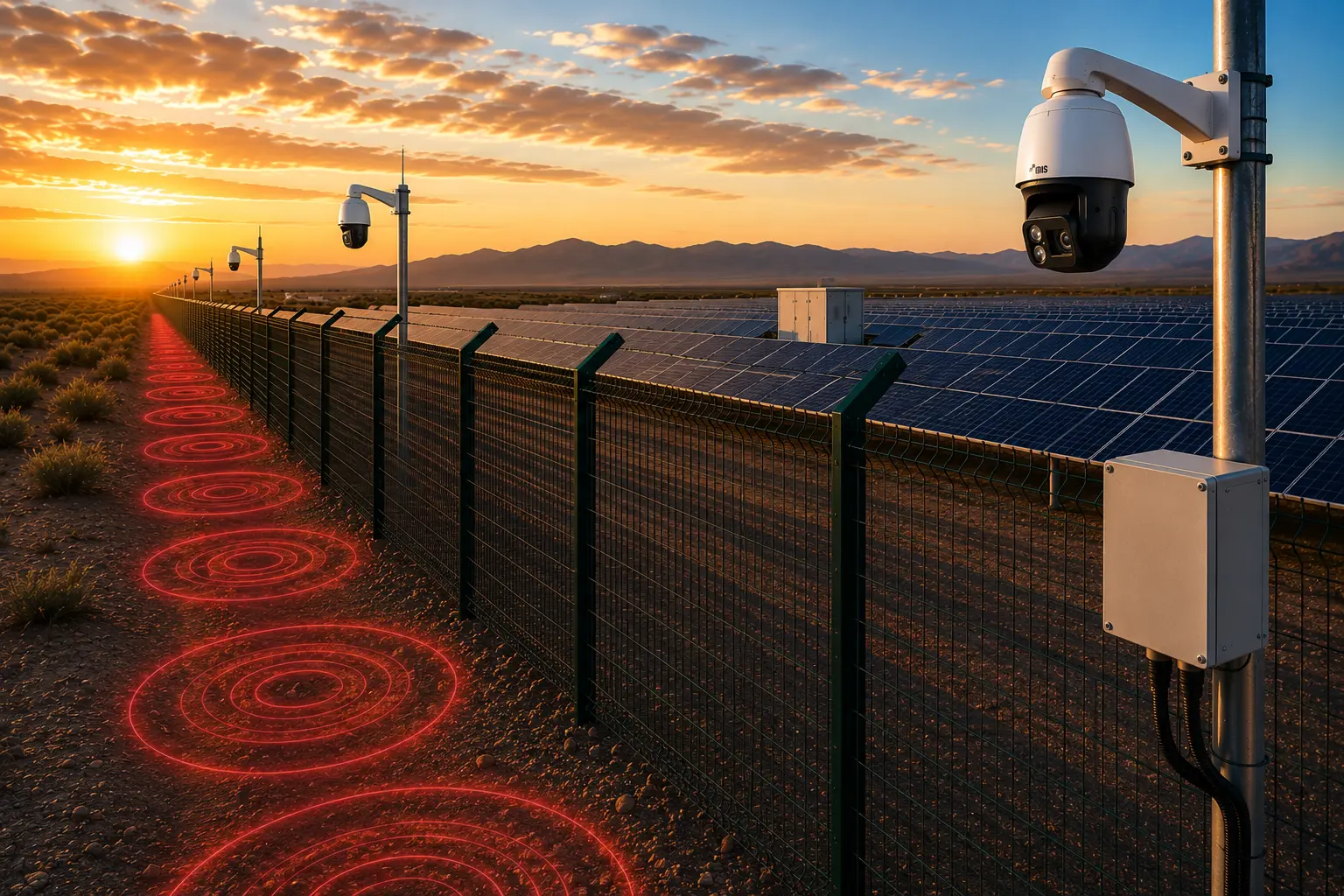
The InvisiFence Plus seismic sensor cable used in the Seismic Shield Pro system protects the ground area surrounding the perimeter rather than the fence itself. Sensors installed underground create a continuous detection zone approximately 6 meters wide and up to 25 meters deep along the perimeter. That zone allows the system to detect people walking along the fence line, individuals approaching the perimeter, attempts to dig under or jump over the fence, and vehicles approaching restricted areas.
Because the system protects the area around the perimeter rather than the fence line itself, intruders cannot bypass it by avoiding contact with the fence. Any attempt to approach, jump, or dig under the protected perimeter generates detectable ground vibrations.
How Seismic Shield Pro Protects Solar Farms
Seismic Shield Pro combines seismic intrusion detection with intelligent camera verification. This architecture provides early detection while minimizing infrastructure requirements.
Early Intrusion Detection with Seismic Sensors
The seismic sensor cable continuously monitors ground vibrations along the perimeter, detecting footsteps, vehicles, and digging activity. Unlike traditional systems that trigger alarms only when the fence is touched or crossed, Seismic Shield Pro can detect suspicious activity near the perimeter before an intrusion occurs, giving security teams valuable early situational awareness.
Intelligent Verification with AI PTZ Cameras
Seismic Shield Pro includes a high-end IDIS 4MP PTZ camera with built-in deep learning analytics and automatic tracking. When the seismic system detects an intrusion, the PTZ camera automatically moves to the exact location of the event, so operators can immediately obtain visual verification of the alarm. After locating the target, the camera's AI tracking function automatically follows the intruder, letting security teams monitor movement across the site. That capability is particularly valuable for remote solar farms, where operators must investigate alerts before dispatching a response team.
90% Reduction in Camera Infrastructure
One of the most significant advantages of Seismic Shield Pro is the dramatic reduction in the number of cameras required. Traditional CCTV-based solar farm perimeter systems require fixed cameras every 30 to 40 meters. In contrast, the seismic detection system allows deployment of one PTZ camera approximately every 460 meters, meaning solar farms can operate with less than 10% of the cameras required by a traditional CCTV system.
| Perimeter length | Fixed cameras (30–40m spacing) | PTZ cameras (sensor-guided, ~460m coverage) |
|---|---|---|
| 2 km | 50–70 | ~4–5 |
| 5 km | 120+ | ~11 |
Lower Installation and Operational Costs
Reducing the number of cameras provides several compounding benefits for a large solar site.
Lower Infrastructure Costs
Fewer cameras require significantly less infrastructure, including camera poles, power supply, and communication networks, which reduces the overall capital expenditure required to secure a large solar farm.
Reduced Maintenance
With fewer cameras deployed, maintenance requirements drop too: fewer visits for cleaning lenses, repairing cables, and replacing damaged equipment. For remote solar farms, that reduction can significantly lower long-term operational expenses.
Efficient Alarm Investigation
Because the system automatically directs the PTZ camera to the intrusion location and tracks the target, operators can quickly determine whether an alert represents a real threat. That helps security teams avoid unnecessary dispatches and respond more efficiently to genuine incidents.
A Smarter Approach to Solar Farm Security
Protecting large renewable energy installations requires security solutions that are reliable, scalable, and cost-efficient. By combining underground seismic detection with intelligent PTZ camera verification, Seismic Shield Pro delivers:
- Early intrusion detection
- Detection of activity near the perimeter, not just at the fence
- Automatic visual verification
- Continuous AI tracking of intruders
- Up to 90% reduction in camera infrastructure
- Lower installation and operational costs
For large and remote solar farms, this architecture offers a more effective and economical approach to protecting critical renewable energy assets. See our full solar farm protection use case for how Seismic Shield Pro applies across different site layouts, or our comprehensive comparison of perimeter security systems for how seismic detection stacks up against fence-mounted sensors, IR beams, and video analytics generally.
Frequently Asked Questions
Why are solar farms targeted by thieves?
Solar farms contain valuable materials such as copper cables and electrical equipment. Their remote locations also make them attractive targets for theft and vandalism.
What is the best way to secure a solar farm?
The most effective solar farm security strategy combines perimeter intrusion detection, intelligent surveillance, and controlled access points.
Can seismic sensors detect intruders before they cross the fence?
Yes. Seismic systems like InvisiFence Plus detect ground vibrations in a detection zone around the perimeter, allowing detection even before the fence is breached.
Why are seismic perimeter systems effective for solar farms?
Seismic sensors are buried underground, invisible to intruders, resistant to tampering, and capable of detecting activity across large outdoor areas, making them ideal for remote renewable energy sites.